
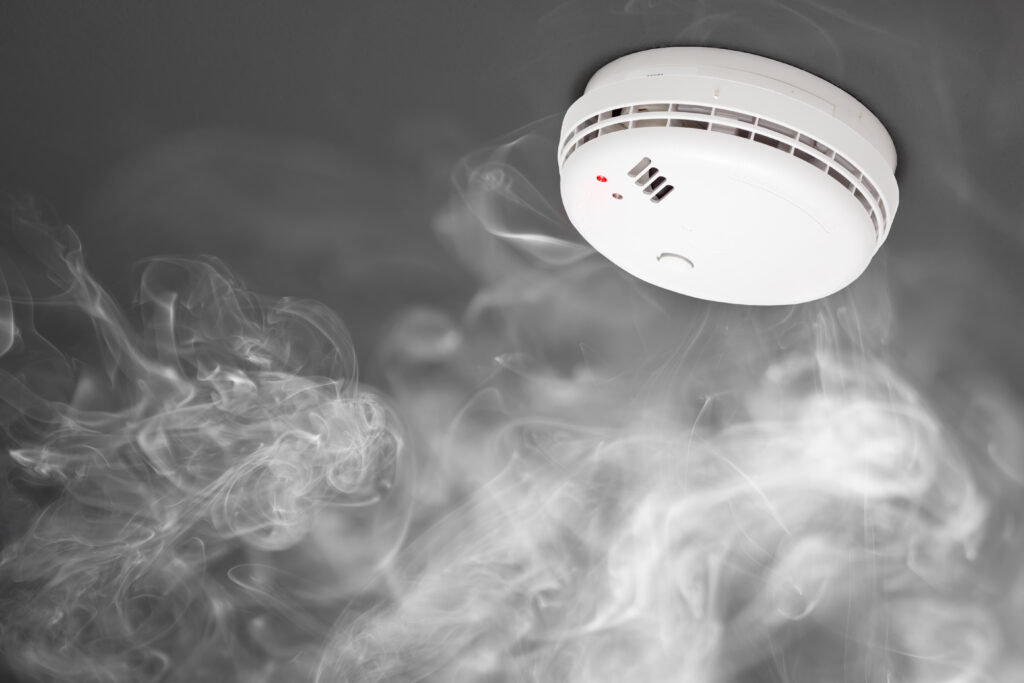
Federal law requires smoke detectors in every residence, but monitored smoke detectors go beyond basic compliance. While battery-operated detectors sound a local alarm, monitored smoke detectors automatically alert the fire department within seconds—even if you're not home, asleep, or unable to call 911 yourself.
The difference between these two types determines whether firefighters arrive while a fire is containable or after total loss. Understanding how monitored smoke detectors work, why they're required in many California buildings, and what makes them more reliable than standalone units helps you make better decisions about protecting your Los Angeles County property.
Most homeowners assume that all smoke detectors provide the same level of protection. They don't. A $15 battery-operated detector from the hardware store will wake you up if smoke reaches the bedroom—assuming the battery isn't dead and you haven't disabled it after too many false alarms from burnt toast.
Monitored smoke detectors connected to central station monitoring dispatch fire trucks automatically, whether you're home or not, awake or unconscious, able to call for help, or completely incapacitated.
How Monitored Smoke Detectors Work Differently
Traditional battery-operated smoke detectors are standalone devices. When they detect smoke, they sound a local alarm—that's it. If you're home and awake, you hear it and respond.
If you're at work, on vacation, or asleep in a remote bedroom, the alarm keeps beeping while the fire spreads. Neighbors might eventually notice, but by then the fire has often progressed beyond the room of origin.
Automatic Fire Department Dispatch vs. Local Alarms
Monitored smoke detectors are wired (or wirelessly connected) to your alarm system's control panel, which communicates with a central monitoring station.
When smoke triggers the detector, the signal reaches the monitoring center within seconds. Operators immediately dispatch the fire department with your exact address and the specific zone that triggered—no verification call, no delay.
The National Fire Protection Association reports that monitored fire alarms enable emergency response before fires spread beyond the room of origin. Every minute counts in structure fires—temperatures can reach 1,000°F within 3-5 minutes, and flashover (when an entire room ignites simultaneously) can occur in under 10 minutes.
The difference between a monitoring center dispatching fire trucks at minute two versus a neighbor noticing flames at minute eight can mean the difference between minor smoke damage and total loss.
California fire code requires monitored smoke detectors in most commercial buildings and new residential construction built after 2014. The state recognizes that automatic fire department notification saves lives and reduces property loss.
Even if your home isn't legally required to have monitoring, the protection gap between monitored and unmonitored detection is substantial enough that most insurance companies offer premium discounts for monitored systems.
The False Alarm Problem with Cheap Smoke Detectors
Battery-operated smoke detectors from hardware stores are notoriously sensitive. Burnt toast, steam from the shower, cooking smoke, even dust or insects inside the sensor chamber can trigger false alarms. After repeated 2 AM false alarms, many homeowners remove batteries or disable the unit entirely.
This is incredibly dangerous. A disabled smoke detector provides zero protection. We've responded to house fires where homeowners admitted they'd removed batteries from detectors months earlier because of nuisance alarms, then forgot to reinstall them.
By the time they smelled smoke, the fire had already spread beyond their ability to control it with a fire extinguisher.
Professional-grade monitored smoke detectors use more sophisticated detection algorithms that reduce false alarms while maintaining sensitivity to real fires. They can distinguish between everyday cooking smoke, which dissipates quickly, and dangerous smoke from smoldering fires.
Many use dual-sensor technology, combining ionization and photoelectric detection methods, which makes them less prone to false triggers from steam or cooking.
When a monitored detector does a false alarm, you can acknowledge it through your keypad or call the monitoring center to cancel the dispatch before fire trucks roll.
Compare that to a battery-operated unit blaring at full volume with no way to silence it except by removing the battery, which people often "temporarily" remove and then forget to reinstall.
Our false alarm prevention guide covers common causes of nuisance smoke detector alarms and how to avoid them. Still, the fundamental difference is that professional-grade monitored units are engineered for reliability rather than the lowest possible cost.
Why Response Time Makes All the Difference
House fires follow a predictable progression. The incipient stage (first 0-2 minutes) produces smoke with little visible flame. The growth stage (2-8 minutes) is when flames become established, and temperature rises rapidly.
The fully developed stage (8+ minutes) is when flashover occur,s and the entire room becomes engulfed.
If you're home and awake when a fire starts, you might catch it in the incipient stage. You can evacuate, call 911, and possibly suppress it with a fire extinguisher.
Fire department arrival at minute 10-12 (typical response time in Los Angeles County) means they're working a defensive operation, protecting surrounding structures rather than saving the origin building.
But if you're not home when the fire starts, a battery-operated detector does nothing except beep at empty rooms. By the time a neighbor notices smoke or flames and calls 911, the fire might be 15-20 minutes in, well past the fully developed stage, possibly into structural collapse.
Monitored smoke detectors completely change this timeline. Detection at minute 1, signal to monitoring center at minute 1.5, fire department dispatch at minute 2, trucks rolling at minute 4-5.
Even with Los Angeles traffic, firefighters often arrive before the fire reaches a fully developed stage. They can make an interior attack, confine the fire to the room of origin, and save most of the structure.
We've had clients whose homes caught fire from electrical faults at 3 AM while they slept. The monitored smoke detectors woke them and simultaneously alerted our monitoring center, which dispatched LAFD before the family was fully out the door.
Fire was contained to one bedroom. Without monitoring, they might not have woken up until smoke inhalation had already incapacitated them—smoke and toxic gases kill more people than flames in residential fires.
California Fire Code Requirements for Monitored Smoke Detectors
California's fire code (Title 24, Part 9) has specific requirements for smoke detection in different building types.
Understanding these helps you know whether your property legally requires monitored smoke detectors or if you're choosing to install them for enhanced protection.
Monitoring Requirements by Building Type
Residential buildings (single-family homes): California requires smoke alarms in every bedroom, outside each sleeping area, and on every level.
For homes built after January 1, 2014, these must be hardwired with battery backup, interconnected so all alarms sound when one triggers. Monitoring is not legally required for single-family residences, though many homeowners choose it.
Multi-family residential (apartments, condos): Buildings with three or more units require automatic fire detection systems connected to a fire alarm control panel. These systems typically require monitoring, depending on occupancy load and building height.
Commercial buildings: Most commercial occupancies require monitored fire alarm systems per California Fire Code Section 907. This includes retail, office, industrial, and institutional buildings over certain square footage thresholds.
The specific requirements depend on occupancy classification, building size, and the presence of fire sprinklers.
Cannabis facilities: California's Bureau of Cannabis Control requires monitored fire alarm systems in most licensed facilities, both cultivation and retail. This is in addition to security alarm monitoring requirements.
Los Angeles County has adopted California's state fire code with some local amendments. Cities like Glendale, Pasadena, and Long Beach enforce these codes through their fire marshal offices, which review plans and inspect installations to ensure compliance.
Even if your building doesn't legally require monitored smoke detectors, adding them provides substantial protection benefits and often qualifies you for homeowners' insurance discounts of 5-20%.
Ionization vs. Photoelectric: Which Detection Method Works Better
Monitored smoke detectors use one of two primary detection technologies or combine both in dual-sensor units. Understanding the difference helps explain why professional-grade detectors outperform cheap battery units.
Ionization detectors contain a small amount of radioactive material (americium-241) that ionizes air molecules between two electrically charged plates. Normal air allows current to flow steadily.
When smoke particles enter the chamber, they disrupt the ion flow, reducing current and triggering the alarm. Ionization detectors respond quickly to fast-flaming fires with small smoke particles—like paper or wood fires.
Photoelectric detectors use a light beam and a sensor positioned at an angle inside the detection chamber. In normal conditions, the light beam doesn't hit the sensor.
When smoke enters the chamber, it scatters the light beam onto the sensor, triggering the alarm. Photoelectric detectors respond faster to smoldering fires with larger smoke particles—like electrical fires, upholstery fires, or mattress fires.
Different fires produce different smoke characteristics. Fast-flaming fires (grease fires, Christmas tree fires) generate smaller particles that ionization detectors catch quickly.
Smoldering fires (electrical shorts, cigarettes in furniture) produce larger particles that photoelectric detectors identify first. The time difference can be 15-45 minutes—critical when every minute matters.
That's why most professionally monitored smoke detectors use dual-sensor technology, combining both detection methods in one unit. If either sensor triggers, the alarm activates.
This provides comprehensive coverage regardless of fire type, which is why California's fire marshal offices increasingly recommend dual-sensor detectors for all installations.
Battery-operated detectors from hardware stores typically use only one detection method (usually ionization because it's cheaper to manufacture).
This saves $10 on the detector's purchase price but creates a protection gap that could cost you everything in the wrong circumstances.
Where to Install Monitored Smoke Detectors
California fire code specifies minimum placement requirements, but optimal protection requires more detectors than the legal minimum. Here's where monitored smoke detectors should be installed:
Every bedroom gets its own detector. This is legally required and makes sense—people sleep in bedrooms, and smoke inhalation while unconscious is the leading cause of residential fire deaths.
Outside all sleeping areas means a detector in the hallway near bedrooms, positioned so smoke traveling from any bedroom or from other parts of the house will reach it before entering sleeping areas.
Every level of the home includes basements, main floors, and upper stories. Even if a level has no bedrooms, it needs detection.
Fires often start in basements (furnaces, electrical panels, water heaters) or garages (stored chemicals, vehicle fires), and smoke rises to upper floors where people sleep.
Optional High-Risk Locations for Extra Protection
Additional high-risk locations where professional installations add extra protection:
Kitchens should have detectors, but position them 10+ feet from cooking appliances to reduce false alarms. Consider heat detectors instead of smoke detectors in kitchens—they trigger on temperature rather than smoke, avoiding nuisance alarms from cooking.
Garages where water heaters, furnaces, or vehicle parking create ignition risks need detection. Use heat detectors here rather than smoke detectors to avoid false alarms from vehicle exhaust.
Attics and crawl spaces where electrical wiring or HVAC equipment might cause fires benefit from detection, even though code doesn't require it. These spaces are unoccupied, so early detection is critical.
Living rooms, dining rooms, and family rooms where people spend time awake don't always get detectors under the minimum code, but adding them increases protection. These rooms often contain ignition sources (fireplaces, candles, electronics) that justify extra coverage.
Valley Alarm installs monitored smoke detectors throughout Los Angeles County in configurations that exceed code minimums for maximum protection. We integrate smoke detection with your intrusion alarm system and video surveillance for comprehensive property protection under one monitoring contract.
Heat Detectors vs. Smoke Detectors: When to Use Each
Not every location should have smoke detectors. Some areas generate enough everyday smoke, steam, or particulates that smoke detectors would constantly false alarm. That's where heat detectors come in.
Heat detectors trigger on temperature rather than smoke. They use one of two methods: fixed-temperature detection (alarm when the ambient temperature reaches 135°F or 200°F) or rate-of-rise detection (alarm when the temperature increases by more than 15°F per minute). Neither method responds to smoke, steam, or cooking fumes.
Use heat detectors instead of smoke detectors in these locations:
Kitchens where cooking smoke would constantly trigger smoke detectors. A heat detector won't activate from burnt toast or searing steaks, but it will trigger if an actual fire starts.
Garages where vehicle exhaust and temperature fluctuations cause smoke detector false alarms. Heat detectors ignore these normal conditions while still protecting against vehicle fires or electrical fires.
Mechanical rooms with furnaces, water heaters, or industrial equipment that generate heat and occasional smoke during regular operation.
Attics in hot climates where summer temperatures might reach 130-150°F. Use 200°F fixed-temperature heat detectors that won't false alarm from normal heat but will trigger if fire-level temperatures develop.
Heat detectors provide secondary protection—they respond more slowly than smoke detectors because fires produce smoke before reaching high temperatures. Never replace bedroom or hallway smoke detectors with heat detectors.
But in locations where smoke detectors would frequently false alarm, heat detectors provide essential protection that homeowners won't disable out of frustration.
All heat detectors we install can be monitored through your alarm system's control panel, providing the same automatic fire department dispatch as monitored smoke detectors.
Maintenance Requirements for Monitored Smoke Detectors
Even professional-grade monitored smoke detectors require regular maintenance to remain effective. California fire code mandates annual testing for monitored systems in commercial buildings, and the same maintenance schedule makes sense for residential installations.
Required Maintenance Schedule
Monthly testing: Press the test button on each smoke detector to verify that the alarm sounds and the signal reaches your control panel. Your keypad should show a smoke alarm activation. Check the wiring connections or replace the unit if the detector doesn't trigger.
Annual sensitivity testing: Over time, dust accumulation in sensor chambers reduces detector sensitivity. Professional testing equipment can verify whether detectors still respond appropriately to smoke concentrations. We include sensitivity testing in annual service visits.
Regular cleaning: Use a vacuum to clean detector vents annually, removing dust, insects, and debris that can interfere with sensor operation. Never paint over smoke detectors—paint clogs sensors and voids UL listings.
Battery replacement: Even hardwired monitored smoke detectors have backup batteries that maintain operation during power outages. Replace these batteries every 3-5 years or immediately when you receive low-battery alerts. Don't wait—low batteries can cause intermittent operation or false alarms.
Detector replacement: Smoke detector sensors degrade over time. California fire marshal offices recommend replacing detectors every 10 years, but we typically recommend replacing them every 7-8 years for maximum reliability. Most detectors have manufacture dates stamped on the back—if yours are older than 2015, plan to replace them.
When we install monitored smoke detectors, we include the installation date on a label affixed to each detector. This helps you track when replacement is due without climbing on ladders to check manufacturer dates.
Our monitoring center tracks low-battery signals and equipment malfunctions, alerting you when maintenance is needed. Compare that to battery-operated detectors, where the low-battery chirp might go unnoticed for weeks or get "temporarily" silenced by removing the battery, which people then forget to replace.
Insurance Discounts for Monitored Fire Alarms
Homeowners' insurance companies recognize that monitored smoke detectors reduce claim severity and frequency. Most carriers offer premium discounts of 5-20% for homes with monitored fire detection, depending on your specific policy and coverage amounts.
The discount calculation varies by insurer, but typical structures look like this:
- Basic smoke detectors (battery-operated, unmonitored): No discount, or minimal credit of 2-3%
- Monitored smoke detectors without fire department notification: 5-10% discount
- Monitored smoke detectors with automatic fire department dispatch: 10-15% discount
- Monitored smoke detectors plus monitored fire sprinkler system: 15-20% discount
For homeowners paying $1,500-2,000 annually for insurance, a 15% discount saves $225-300 per year—enough to offset monitoring costs.
Commercial property insurance discounts for monitored fire alarms are even more substantial, often reaching 20-30% for buildings with comprehensive fire detection and suppression systems.
For commercial properties in Glendale, Pasadena, or downtown Los Angeles, these discounts can amount to thousands of dollars annually.
To claim your discount, provide your insurance agent with documentation that your system includes monitored smoke detectors connected to UL-listed central station monitoring. We provide this documentation as part of every installation.
What Happens When Monitored Smoke Detectors Trigger
Understanding the response sequence helps you appreciate why monitored smoke detectors provide superior protection compared to standalone battery units.
- Second 1-3: Smoke detector activates. The signal transmits to the alarm control panel. Panel identifies which zone triggered (bedroom, hallway, kitchen, etc.) and sends a signal to the monitoring center.
- Second 4-10: The Monitoring center receives an alarm signal. Operator sees it's a smoke/fire alarm (not intrusion alarm) and immediately dispatches the fire department. No verification call—fire alarms get instant dispatch under industry protocols.
- Second 11-30: 911 operator receives a call from the monitoring center with your address, the triggered zone, and any special instructions regarding occupants or hazards.
- Minutes 2-5: Fire department dispatches engine company. In Los Angeles County, structure fire responses typically get 1-2 engines, one ladder truck, and a battalion chief for single-family residences.
- Minutes 5-12: First engine arrives on scene. Response time varies by location—downtown Los Angeles might be 5-6 minutes, while outlying areas might be 10-12 minutes.
Throughout this sequence, your local smoke detector also sounds its alarm, waking occupants and alerting neighbors. But the critical difference is that fire trucks are already rolling, regardless of whether you can call 911 yourself.
Compare this to an unmonitored detector: You wake up, maybe call 911 if you're conscious and thinking clearly, try to describe your address while panicking, and hope the 911 operator understands you clearly.
The fire department gets dispatched maybe 2-5 minutes after the alarm starts sounding. Add those 2-5 minutes to normal response time, and you're looking at fire department arrival 7-17 minutes after fire detection rather than 5-12 minutes.
Those extra minutes matter enormously when fire can double in size every 30-60 seconds during the growth phase. This is precisely why California fire code increasingly requires monitored smoke detectors in commercial buildings—the life-safety and property-protection benefits are too significant to ignore.
Cost of Monitored Smoke Detectors vs. Battery-Operated Units
The upfront cost difference between monitored smoke detectors and battery-operated units seems significant until you consider the protection gap and long-term value.
Battery-operated smoke detector: $10-40 per unit at hardware stores. No installation cost if you install yourself. No monitoring fees. Replace batteries annually ($5-10/year per detector). Replace the entire unit every 8-10 years.
Monitored smoke detectors: $75-150 per detector, including professional installation. Monthly monitoring fee $10-30 (typically bundled with existing alarm monitoring, not a separate charge). Replace batteries every 3-5 years. Replace detectors every 8-10 years.
For a typical 2,000-square-foot house requiring 6-8 detectors:
Unmonitored route: $60-320 upfront, plus $30-80/year in batteries = roughly $500-1,100 over 10 years with zero professional monitoring.
Monitored route: $450-1,200 installation, plus $15-20/month added to existing monitoring ($1,800-2,400 over 10 years) = roughly $2,250-3,600 over 10 years with 24/7 professional fire department dispatch.
The difference is $1,750 to $2,500 over a decade. But remember:
- Insurance discounts of 10-15% can save $225-300/year, recouping $2,250-3,000 over 10 years
- One prevented total loss, or fire pays for decades of monitoring
- You can't put a price on the life safety benefit of guaranteed fire department notification
Many clients bundle monitored smoke detectors with their existing intrusion monitoring, adding fire protection for just $10-15/month additional—less than two coffees.
For that price, you get professional-grade equipment, automatic fire department dispatch, annual maintenance reminders, and insurance discounts that often exceed the cost of monitoring.
Getting Started with Monitored Fire Protection
If your home or business only has battery-operated smoke detectors, upgrading to monitored smoke detectors is straightforward. We can integrate smoke detection into existing alarm systems or install standalone monitored fire systems if you don't currently have security monitoring.
For homes with existing alarm systems, adding monitored smoke detectors typically takes 2-4 hours. We mount detectors in code-required locations, run wiring (or install wireless detectors), program zones into your control panel, and test everything to ensure signals reach the monitoring center correctly.
For commercial properties, we coordinate with your fire marshal's office to ensure fire alarm system design meets California Title 24 requirements. This includes detector placement, notification appliances (horns/strobes), fire alarm control panel selection, and monitoring center certification.
We serve all of Los Angeles County, including Glendale, Pasadena, Long Beach, the Inland Empire, and Orange County. Our technicians are factory-trained and California State Fire Marshal-certified for fire alarm installation.
Request a consultation, and we'll evaluate your current smoke detection, recommend appropriate upgrades, explain monitoring options, and provide detailed proposals for bringing your property up to optimal fire protection standards. We'll also help you claim available insurance discounts and ensure any new installation meets local fire code requirements.
Don't wait until after a fire to wish you'd had better protection. Monitored smoke detectors provide peace of mind knowing that even if you're not home, someone is always watching over your property and ready to dispatch help the instant danger is detected.
Related Articles
Fire Safety & Protection
- Fire Alarm Systems for Los Angeles County
- How Alarm Systems Work
- What is a Central Station and Why Be Monitored?
Alarm System Maintenance

- How Remote Video Monitoring Replaces Security Guards [Save $8K/Month] - February 4, 2026
- Remote Video Monitoring FAQs (For Businesses) - December 30, 2025
- Video Guard Monitoring for Cannabis Businesses Part 2 - May 5, 2022